- Corporate
- Market Info
Ten Years of Danish Investment in France: 2015–2025
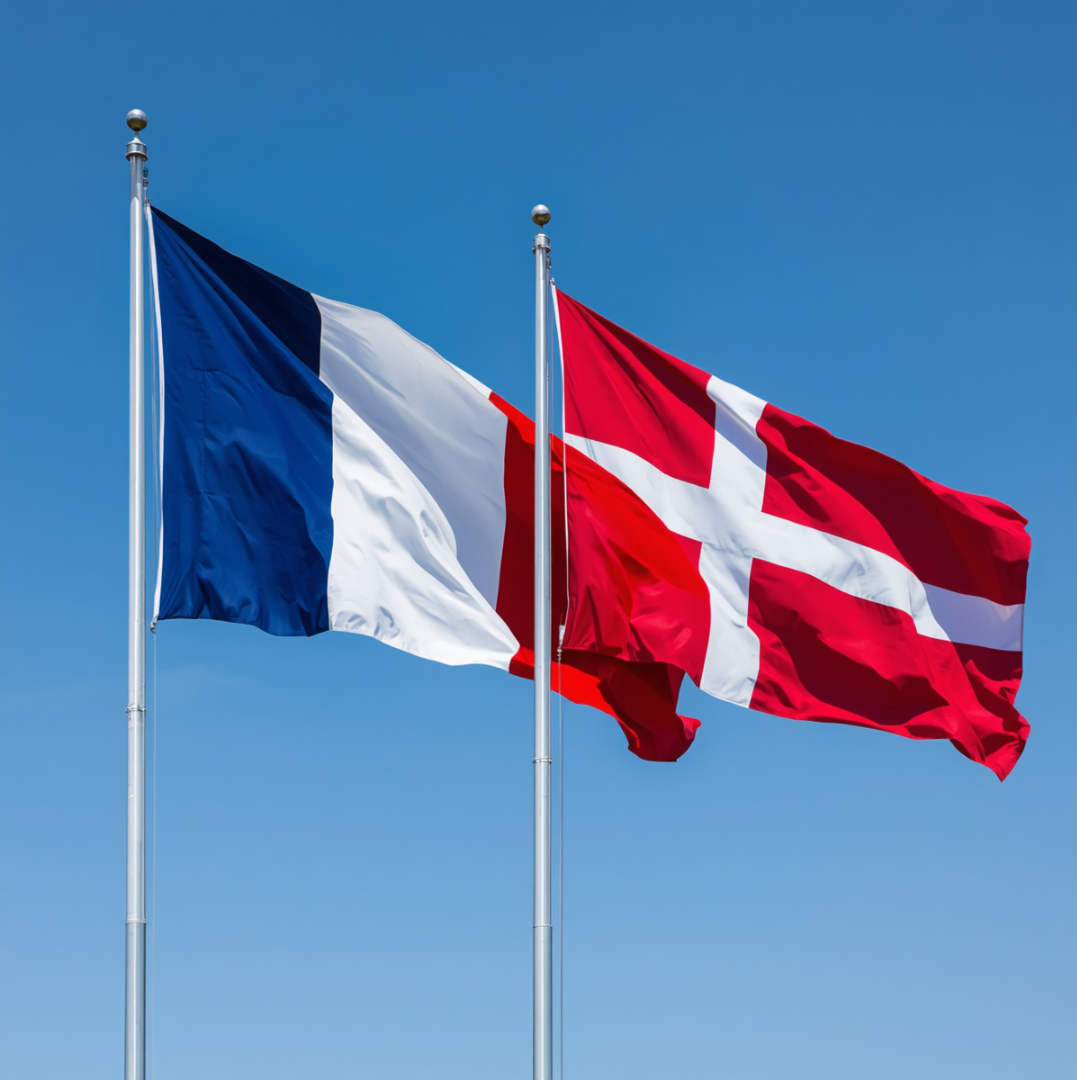
Between 2015 and 2025, Danish investment in France accelerated markedly, visible both in the number of projects and in the economic footprint associated with them. Over the period, 437 establishment or expansion projects were recorded, creating around 7,600 jobs. This very positive dynamic is now visible at national level: in Business France’s Annual Report on International Investments in France in 2025 , Denmark, for the second year in a row, appears in France’s Top 10 investor countries both by number of projects (10th) and by jobs (7th), ahead of countries such as China and Spain.[1]
A clear acceleration in projects and employment over ten years
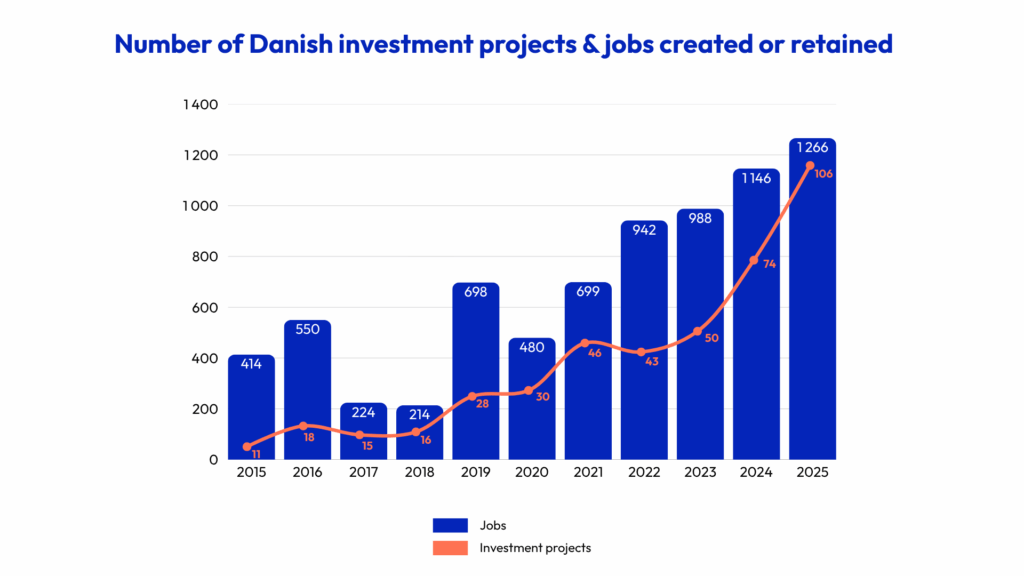
Taken together, the data over the 2015–2025 period reveal a strong and sustained increase in Danish investment activity in France, both in terms of project volumes and employment impact.
The years 2015 to 2018 represent an initial period of stability, with investment activity remaining broadly steady. Over these four years, Danish investment in France averaged around 15 projects per year, generating approximately 350 jobs annually, reflecting a consistent but measured level of engagement.
After 2019, a second phase emerges, marked by a sharp acceleration in project volumes and a clear change of scale. From 2019 onwards, Danish investment activity intensifies significantly, with an average of around 53 projects per year and approximately 888 jobs created annually, culminating in 2025 as a record year with 106 projects and more than 1,200 jobs created. This end‑of‑decade spike confirms that the recent momentum is not incremental but reflects a genuine intensification of Danish investment activity in France.
Beyond annual flows, this dynamic is also reflected in the growing employment stock of Danish affiliates. Danish companies’ employment footprint in France nearly doubled in 10 years, rising from roughly 15,000 in 2015 to around 27,000 in 2025*, signalling long‑term anchoring rather than short‑term investment cycles.
Employment growth driven by a diversified and resilient sectoral base
The strengthening of Denmark’s economic footprint in France is underpinned by a set of long‑established sectors. Logistics and outsourced services play a major role, accounting for around 40% of Danish jobs in France, driven notably by the strong expansion of players such as DSV, whose headcount rose from around 850 employees in 2015 to more than 7,500 today following acquisitions and platform development across the country.
Healthcare and life sciences form another core pillar of Danish presence. As life sciences represent close to 20% of Danish merchandise exports, this industrial strength is clearly reflected in France through sustained investments by major groups such as Novo Nordisk, Coloplast, LEO Pharma, Lundbeck and Demant. [2][3] Novo Nordisk employed around 2,300 people in France in 2024 and continues to expand, Coloplast has reached around 700 employees, and Demant reinforced its footprint following the acquisition of Audika.
Industrial activities also illustrate durable anchoring, with companies such as Velux, Rockwool, Grundfos and Danfoss combining production and commercial functions. In parallel, Vestas has significantly expanded its workforce linked to wind energy deployment and maintenance, with headcount roughly tripling over the decade.
Overall, Danish activities in France combines established strengths in logistics and outsourced services, a strong life‑sciences pillar, and durable industrial operations. This positioning is fully consistent with France 2030 investment plan, which prioritises decarbonising the economy and accelerating innovation in key strategic sectors, including health and industrial transformation.
Retail as a major driver of project volumes and investment dynamics
One of the most striking features of the 2015–2025 cycle is the rapid expansion of Danish retail in France, which explains a decisive share of recent project volumes. Built on repeated, unit‑level decisions, retail projects have multiplied sharply in recent years, accounting for 31 projects in 2021, 52 in 2024 and 85 in 2025.
Normal’s expansion is particularly emblematic. Established in France since 2019, the brand operated more than 80 stores by the end of 2025 and represents around 2,000 jobs. Other players have followed similar trajectories, with Jysk reaching around 40 stores in 2025 and Bestseller multiplying smaller‑format store openings.
While the growing weight of retail mechanically reduces the average number of jobs per project, this trend coexists with more job‑intensive investments in healthcare, industry and logistics. When projects outside retail and distribution are isolated, the number of non‑retail projects also increases over time, rising from 11 in 2015 to around 22 in 2024 and 21 in 2025. This confirms that retail acts as a powerful amplifier of overall investment volumes, rather than masking weakness in other segments.
Cooperation Opportunities Emerging from a Strong Investment Cycle
Taken as a whole, the 2015–2025 cycle is highly favourable for Denmark’s economic momentum in France. Project volumes rise sharply, with a clear acceleration at the end of the period; the employment footprint of Danish affiliates increases significantly.
Beyond overall investment momentum, several priority sectors emerge as natural grounds for strengthened Franco‑Danish cooperation. The ecological transition constitutes a natural field of partnership, given Denmark’s strengths in green technologies and France’s decarbonisation agenda. This agenda is notably structured by the National Low‑Carbon Strategy (SNBC), which aims for carbon neutrality by 2050 and a reduction of territorial emissions by around 50% by 2030 compared to 1990.[4] Healthcare and biotechnologies are a second structuring domain, illustrated by several well‑established players and projects across France. Logistics and low‑carbon transport form a third axis, where both performance and sustainability of supply chains are central. Finally, the transformation of retail, including omnichannel models and logistics, naturally extends the recent retail boom and is expected to support long‑term value creation.
In this favourable context, the current momentum represents a concrete opportunity for Danish companies to invest in France, engage in this new wave of projects and contribute to the development of high‑potential sectors supported by public policies and targeted incentive schemes, underpinned by the €54 billion France 2030 national investment plan.[5]
Business France’s advisors and experts are on hand to support Danish companies at every step of their investment journey in the French market. Contact us here !
Article written by Paul AUZELOUX
* The figures presented here exclude ISS, which withdrew from the French market in August 2023 (ISS alone accounted for around 25,500 employees in France in 2015).
**Data are drawn from Business France Nordics’ records of investment projects and associated jobs since 1993.
References
[3] The Trade Council Denmark – Global Industry Team for Healthcare Exports
May interest you
Ten Years of Norwegian Investment in France: 2015–2025.
Ten Years of Finnish Investment in France: 2015–2025
Nordic–French Bluetech Synergies: Investing in Europe’s Leading Maritime Powerhouse
A.I. & Industry: the 2024 Finnish investment footprint in France
Norwegian investments in France in 2024: stronger ties & greener ambitions